

A picture’s worth a thousands words…
–and I’d like to believe this was not some Confucian phrase but a newspaper editor budgeting column inches.
I am one of those people who saves gifs (and images) in conversations with myself on Slack (or Teams 🤮). I do this because there was a Deepfake Image app where you could pay $5/mo and put your face over gifs. I did not want to spend $5/mo continually, so I considered my most frequently used emojis and reactions and made a deepfake of myself to iconic gifs that’d best cover the spectrum of my… professional emotions. Then, to ensure I could slot these into a conversation on slack or text at any given moment, I engaged in a slack DM thread (with myself), dropping each gif in, so they’d be ready to use at a moment’s notice.
While I still save gifs in conversations with myself, stuff also disappears into the internet ether. And the older I get, the more difficult it is to find certain gifs and graphics. So I’ve started saving gifs and graphics and uploading them to a draft of this blog post since September 2022 to ensure “I’m” hosting the image and don’t need to be reliant on a third party.
Now all that said, this blog post started as utility for myself, but I thought of a productive use case to make it more accessible. What follows is a bunch of gifs/graphics I’ve used frequently (sometimes daily) working in an agency… but what I plan on sharing is how to STOP using them, i.e. most of these are used out of recurring inconvenience, but there is a solution to all of them.
1. Tire Swing Infographic: Document EVERYTHING
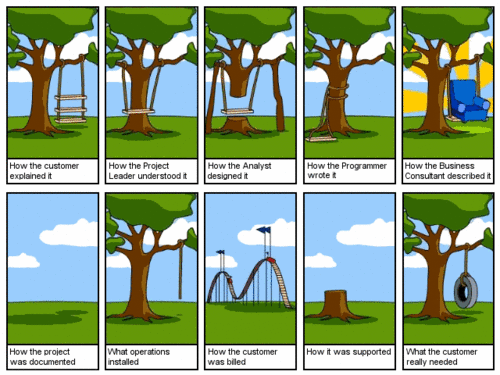
I’m still a fan of this age-old meme — even more modernized revisions to it are pretty good — but the part that resonates with me regardless of job or company is the bottom left: how the project was documented.

In case it’s not clear, the graphic indicates the project was NOT documented — and it rarely is.
This is a lesson I learned in 2015 when I was working in SEO & SEM. I had a bunch of small clients for a burgeoning agency and one was a lawyer who specialized in the removal of DUIs from peoples’ records. He paid us about $1,000/mo and I’d gone over with him why we can’t target “remove DUI from my record” since it (and its variants) cost upwards of $75/click. Meanwhile, “expunge my record” was $1.50/click and clearly someone who has done the research to know what they’re looking for. They agreed to the plan… until two weeks in when the lawyer called me, irate, wanting more visibility NOW. I told him it’d blow through the $1,000/mo budget and he — out of nowhere — asked “why are we spending $1,000/mo? We should be spending at least $5,000!” So I agreed to increase the monthly budget and relayed all this to my boss.
By month’s end we’d indeed spent that money (and then some), to which the lawyer sent a calculated email saying our contract clearly states we’re not to spend more than $1,000/mo; as such, he’s not responsible for the cost of this month’s ad spend and expects us to ostensibly “eat” the cost. I was young, so of course I told my boss this isn’t fair. We called the guy and I relayed the conversation on [DATE] you called and said, [THE ABOVE SPEIL] and the lawyer said, “Do you have that in writing?”
Of course, I did not.
From that kerfuffle, I’ve made an effort to document everything. It’s why clients get Agenda emails a day prior to a meeting and Follow-up emails after the meetings. It’s even why, when something seems so obvious, it doesn’t need to be written down… it gets written down.
And this goes beyond client work. There are dozens of times where I go on autopilot and if someone asks, “hey, how’d you do that,” I go blank. So I write it down as I’m doing it and it’s often only in reviewing what I did, do I find out how to streamline.
Sidebar: with AI, this is exponentially more valuable now. Get those prompts in writing. Save those scripts in Google Colab. ✌️
2. Cutting into a Spool of Yarn with an Exact-O Knife: Can I Borrow You For A Minute?

This happens as often in life as it does at work. A slack message, a rapping on your office door, “hey do you have a minute?”
It’s never a minute.
It’s an ad hoc distraction from whatever you’re working on — a quick win, we think — when in reality, it’s inevitable scope creep. The proverbial “open a can-of-worms”… but I think a spool of yarn with an exact-o knife is far more satisfying.
And why?
Just to pivot from whatever it is you’re currently doing to whatever it is the requester suddenly wants you to help with, will probably take about 5-10minutes. Even if all the person is asking is help figuring out how to alter an excel formula, you need to understand the context of what they’re trying to achieve; you need access to the file they’re working out of; you need to think about if an Excel formula actually solves their problem. It won’t be a minute and if it’s not resolved in that first 10minutes, then congrats, now this is floating in the back of your head while you try to resume whatever it was you were working on.
Derek Digresses: One of my favorite articles during the pandemic was this one where two working parents (suddenly working from home) split the day 50/50. Wherein, their (4) kids would go to dad with any and all complaints/help/issues for the first 3 hours of the day, then they would all defer to mom for the latter 3 hours of the day. This way, both parents have split child-rearing duties and each is guaranteed 3 uninterrupted hours of work. Simple enough…
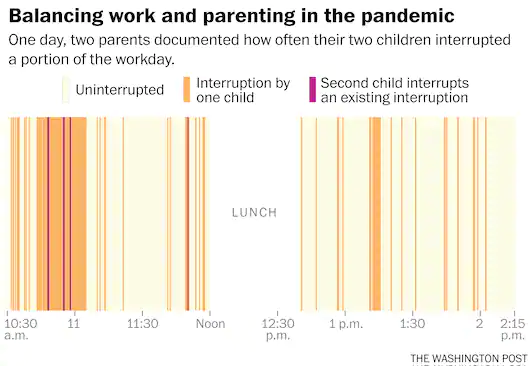
On average, each parent (on child-rearing duty) averaged 30minutes of interruption. This means that out of the 3 hours where they were on-call, they had 2.5 hours of working time. Cool! That sounds great. So what’s the problem?
“But that time didn’t come in clean chunks: The parent was interrupted 45 times, an average of 15 times per hour. The average length of an uninterrupted stretch of work time was three minutes, 24 seconds. The longest uninterrupted period was 19 minutes, 35 seconds. The shortest was mere seconds.”
-Suzanne M. Edwards and Larry Snyder
Afterward, “it can take upward of 20 minutes for people to get back to the task at hand after an interruption, and the quality of their work declines. People skip steps in their projects when they attempt to refocus, studies have found, or repeat steps they’ve completed.”
So how do you NOT wind up cutting open a spool of yarn?
Have an open calendar where people can book time with YOU.
This was shown to me by a former colleague (Arpun) using frogs and monkeys. The whole “eat the frog” and “don’t adopt monkeys.” They showcased how if someone approaches you for help, you jumping in to help means you’ve now adopted their monkey. Now you have less time in the day to do the things you need to do. So to solve it… tell people to book time on your calendar — if your calendar is full, they’ll find time on another day; if it’s urgent, they’ll find someone else.
By keeping the onus on them, it’s not your problem (monkey) to solve (adopt), and they solidify time to meet. Maybe you’ll wind up with “more” time since the meeting takes 15 minutes (it won’t), but this way you’re not constantly winding up with a messy spool of yarn. Sometimes all someone needs is a day to think about it instead of feeling pressure like it’s not going to get done otherwise.
3. Joey Tribbiani’s That’s a Great Story, Can I Eat it?: Action Items and Revenue in a Nutshell

You know this one, I know this one — I mean, I’ve made a YouTube video on this one (timestamped for reference). Working in SEO, I find weird stuff all the time, sometimes there’s fascinating stuff, stuff I’ll share with my family and co-workers — even my friends because it’s weird but funny and nuanced and exciting… but little of it matters to a paying client.
Nowadays, I use this gif more for for QA as a low-stakes, but nonetheless careful reminder, for people to ask “what’s the get?” “why should I (the client) care?”
I am an SEO nerd and I love anecdotes, but when delivering to someone, I want to emphasize the value; you do that with clear action items and takeaways, i.e. an executive summary.
In an ideal world, every deck’s headline would lead with the action (e.g. we’re going to localize these products), the bullets would prioritize or showcase the steps… then the “story” / “talk track” is if they (the client) asks, “Why?”
Otherwise, assume they’re onboard and they simply need to know what’s next.
And to be clear, I think story-telling is INTEGRAL in marketing (and especially new business / sales), but it’s for a different element. If you’ve just completed a tech audit, a story is ONLY going to obfuscate what you need to do next. If you’re pitching a content strategy however, you NEED to tell the story. Show them why the content they’re focused on isn’t working and what your creative approach is going to be and why you’re sure it’s going to work. That takes more slides, more of a narrative. I know I’ve used this example half-a-million times, but if you came out the gate to the MARS company and said, “we’ve created your M&Ms candy into IP by creating CGI characters for each color,” you’d probably get some pushback from the company saying, “Wait, hold on a minute, what are you doing and why?! Have we asked for this, did we pay for this?!” Vs giving them a narrative that shows why having a family-friendly mascot that doesn’t age is ideal.
4. Spinning Plates Gif: I have too much sh!t to do!

I used to wonder what the role of a “manager” was. I was one of those people who felt, “if I’m doing the work? What the hell is my boss doing?” I remember looking this up years ago too, and discovered how the higher up you go, the more time you have to simply think. That however was an unsatisfactory answer to me. How do you quantify thinking as a tangible asset?
As a result, in many scenarios when I was asked to assist an account, I’d identify where they’re overloaded and serve as the gap filler. Effectively, instead of coach — or even a quarterback — I was a tight end (TE); I could serve as a receiver, blocker or running back if needed. For some jobs, this is what I felt was my greatest strength: I’ll adapt — even if I’m not an expert, I’ll figure out how to do it and acquire a new skill in the process.
However, AI Search might’ve been the first time in my career where I felt 100% entitled to thinking time. There were so many studies, articles, and of course, misinformation. It wasn’t uncommon for me to read an article, investigate the validity of the author — check out their previous articles — and dig into subreddits and webinars, pester LLMs, and post publicly and privately in LinkedIn comments to get answers on parts I didn’t understand.
Once I finally felt confident in what I knew and could speak to what I didn’t know. It came time to meet with various teams and their clients to do an AI Search presentation. Account leads did not have the luxury of thinking time that I did. I never lorded over people or said, “you should know this” because I understood this was my value add.
So when I notice that I start to feel like I’m spinning plates, I’m not thinking, I’m reactive. I’m covering today’s problems, not the future state and it took me a decade of working between agency and in-house before I understood why you NEED someone who is thinking about the future state. An account lead is working on that monthly report, you need senior-level person already flagging the need for a QBR. So if you feel like you’re spinning plates, what’s the fix?
Time to hire someone.
I’m a neurotic time-tracker. In part because sometimes I’d feel like I’ve been working on something for hours, but when I sandwich the time down, it was really 3 collective hours — at which point I realize, “oh, this is living rent-free in my head, I need it gone, NOW.”
I’ve been avidly time-tracking myself (in Toggl) since 2015. And when I was working at PeopleConnect (in 2018), this was the first time in my career where I used that to advocate for myself to get a new hire. PeopleConnect didn’t time-track, but I did, and when my boss resigned, I netted 330% more meetings which was limiting my output. I brought this to my new boss and they said, “Let’s get you a direct report.” I was gobsmacked. I quantified it and I double-downed my efforts to time track religiously.
Especially as I worked various jobs with high turnover. It is IMMENSELY powerful to go back through my personal time-tracking and say, “I know exactly where my time went in June. I know what all the travel in January cost me. I know how much time that “raging fire” actually cost me. And — although we’ve never fired a client on my account — I have advocated (two times for two different clients) for the agency to fire clients. I can show the numbers, what it costs to keep them happy and this has only served me well.
5. If You’re Good at Something, Never Do It for Free: Scope Creep vs Upselling

Sidebar: This is actually 1 of 4 Joker graphics I use consistently. And while the name “Joker” works semantically for my “Humorist”, I do acknowledge that trusting a psychopath’s business savviness isn’t the best look… but I stand by it.
Something I’ve seen a lot of fellow SEOs struggle with is upselling / cross-selling. They adopt your stereotypically sleazy salesperson persona — and they DON’T like this persona. They want to provide value and honesty, but they struggle to do it and I have a strong suspicion I know why.
SEO is People-Pleasing. Someone has a question and you need to be the answer. Analyze how and why you are the appropriate answer and if your engagement is low, analyze how and why you’re NOT the right answer so you can become the answer. And this is in direct opposition to an upsell where, in many cases, no one asked, and you’re answering.
So a lot of people do additional work for free in an effort to please a client or turn an ad hoc deliverable into a whole BIG deliverable. So how do you stop?
Write a brief.
And this isn’t a time-sucking thing — especially since I’ll give you the prompt down below you can use to create a custom Gem:
Prompt for a One-Page Brief
You are an SEO expert with strong project management expertise. Your role is to create clear, realistic project briefs, prevent scope creep, and set achievable timelines.
—
Task
When I ask you to create a brief for a specific initiative (e.g., “Content Audit”), generate a complete project brief using the fields below. Treat this as a consultative, strategic deliverable unless otherwise specified.
—
Required Project Brief Sections
Provide the following, clearly labeled and concise:
1. Project Name
(Campaign name)
2. Project Description
(High-level overview of what is being delivered)
3. Business Challenge
What problem are we ultimately solving?
4. Objective
Why this work will solve the business challenge
5. KPIs
– If performance-based: traffic, rankings, conversions, etc.
– If consultative: client agreement with findings, clarity on priorities, approved next steps
6. Target Audiences
– Specific audience(s), site sections, subfolders, or internal stakeholders
7. Main Message
If this project achieves one thing, what is it?
(It’s acceptable if this overlaps with the Objective.)
8. Channels Impacted
Teams or channels affected (e.g., SEO, Content, Paid, Social)
9. Implementation / Instructions
Step-by-step description of how the work will be executed
10. Budget (Hours)
Estimated total hours required
11. Regions
(US, International, or specific geographies)
12. Duration
Estimated project length and, when possible, date range
13. Considerations
All known risks, dependencies, assumptions, or open questions that could affect scope or outcomes
14. Data Platforms
Tools required (e.g., Google Analytics, Search Console, Conductor, SEMrush, Ahrefs)
—
Aspirational Timeline Requirements
After the brief, include a clear, phased timeline that accounts for the following mandatory steps:
1. INT Discovery Scheduling – 3 business days
2. INT Discovery Meeting – 1 day
3. Brief Creation – 1 business day
4. EXT Review & Approval of Brief – 5 business days
5. Execution Phase
– Include all steps required to complete the project
– For large or strategic deliverables, include INT QA checkpoints at:
— 50%
— 75%
— 100%
6. EXT Presentation of Deliverable – 1 day
7. Post-Delivery Phase – 5 business days
– Either:
— Ad hoc revisions / tweaks
— OR, if no revisions are needed: internal post-mortem (what worked, what didn’t, how to improve next time)
Timelines should be realistic, clearly sequenced, and aligned to the stated scope and budget.
—
Clarification Rule
If you are less than 95% confident in any part of the brief due to missing or ambiguous information, pause and ask targeted follow-up questions before finalizing the response.
A brief helps to define the scope of a project to ensure the client gets their desired outcome and you give yourself clear barriers. Anything beyond those barriers is a possible upsell. What’s more a brief like this bakes in time for discovery and revisions. The revisions should be minor, but if there’s no revisions, it clearly states that you’ll see what you could develop to make it function better next time. That’s the upsell. If you’re doing great work and you want to be doing more great work, then this is such an easy way to say, “Hey, I want to use more of my limited time servicing your account, to do that I need to convince my bosses it’s worth it.”
It’s not that different from asking for a raise, i.e. I’m giving you my time, I’d like to continue giving you my time, but for me to have the same enthusiasm and not feel resentful, my rate has increased. The power is not in the hands of the company — and, for anyone that needs to hear it, hiring someone “new” is WAY more expensive than giving someone a raise; anyone who says differently is naïve at best and arrogantly inexperienced at worst. The amount of time to find reasonable candidates, let alone interview with experienced team members, let alone onboarding, not to mention the blow to the team’s morale is WAY more costly.
Honorable Mentions
Yeah, okay, while I have fixes to those, I also have some gifs that so perfectly encapsulate my feeling and catalogue of media. These don’t necessarily have fixes, but I’ve used them enough that they’re impossible to ignore.

There’s been some days where the hits keep coming. I’ll never forget when, on my first month on the job, 3 core, senior (irreplaceable) people put in their notice. Little Baby’s Ice Cream just captures that surreal… “my brain is mush, yet I can’t stop working.” I will at some point finish my post on my favorite commercials (this is one of them).
Now I cannot stress enough, no one ought to work more than their normal working hours. It’s just, as someone who clearly sees SEO as a hobby as much as a job, I often do. It’s not something I expect of people I work with, however it’s partly what led me to using the following two gifs in conjunction.

Especially during meeting heavy weeks, the normal working hours feels nonstop whereas after hours, I can take time to futz with scripts and products.