

Show Your Work: Turning Chicken Scratch into Polished Poultry
Let me set the scene.
A new CMO has invited the in-house senior marketing manager (your client: the who is the one responsible for organic revenue for their company and YOUR agency’s continued contract) into an ominous closed door meeting. This is doubly worrisome as the previous week, the CMO had requested a high level overview from each of the department heads, in which:
- Paid showed incredible Y/Y gains, bumps in efficiency, their shared calendar of daily stand-ups, and alerts to ensure paid efficiency as well as ad copy that showcased how they’ve iterated.
- Influencer showed their rolodex of talent and agencies and some of their most-shared creatives with long-standing clients and how they track trends and brainstorm ideas.
- Social showed demographic data, breakouts by platform, post frequency, a comprehensive calendar, and some of their top performing, platform dependent posts and where they’re looking to grow or expand.
- SEO showed revenue, traffic, and visibility across Google and LLMs and showcased the emerging AI Search.
…and this is what prompted the CMO to followup with the SEO head. The CMO requested examples.
Scene Start.
CMO: What am I looking at?
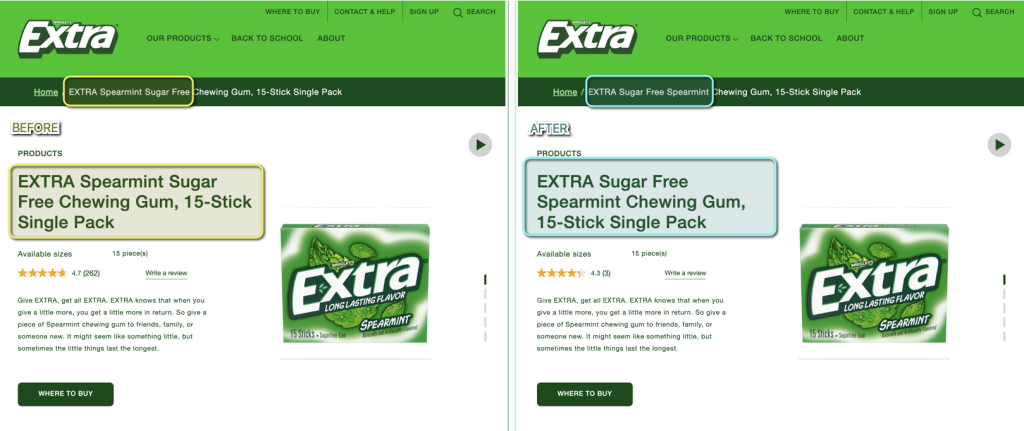
Sr MGR: We captured over 70 million new searches by digging into the data and finding out users search for a healthy modifier (like sugar free) before they select a flavor (like Spearmint). So now we’ve changed all our product pages (with an applicable health modifier) to appear first instead of putting the flavor first. And we created new filters to support more health conscious modifiers like “teeth whitening” and–
CMO: How long did this take you?
Sr MGR: This was like 2 months of research.
CMO: (In the most level-headed paraphrase) Why wouldn’t you just A/B test it? Why spend 2 months researching the sequence of adjectives when you could go live in month one and measure in month 2? It just seems like a lot of time is spent researching something that I’m sure most people here would already assume to be true.
Sr MGR: (Increasingly nervous) We also added schema.
CMO: What’s that look like?

CMO: What’s the difference?
Sr MGR: Well, you can’t see the difference, but it’s there.
CMO: (Readying the firing squad) Can you show me what an average deliverable looks like?
Sr MGR: Let me pull up that audit…
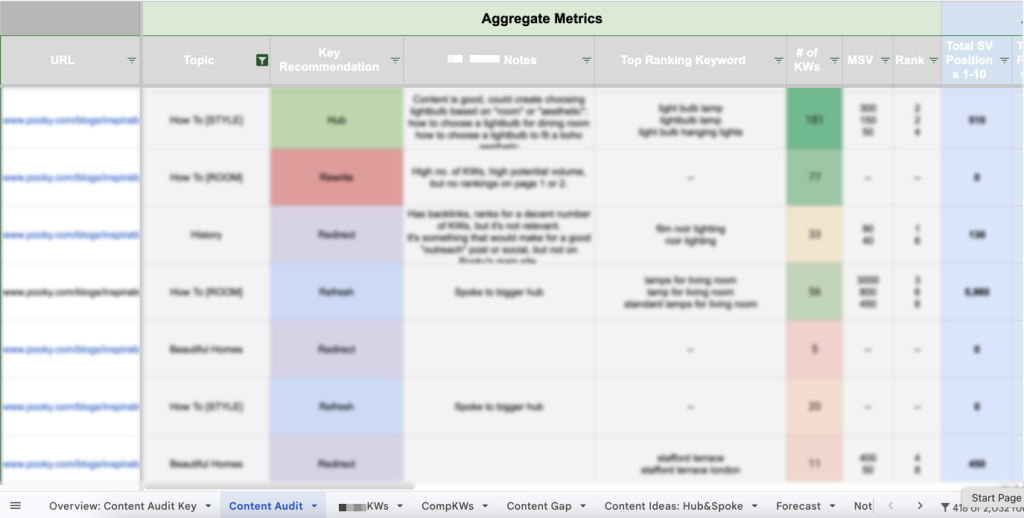
CMO: …Jesus Christ.
And Scene.
“Show Your Work” is a Metaphor, NOT a Directive
There’s a lovely irony that the math mantra of “show your work” has been uttered more times in my content (language arts / English) career than anything remotely literary. However, I’ve seen this phrase used literally instead of what it ought to be taken as: metaphorically.
I know this because I’ve been guilty of this.

There’s a high that comes from opening up a spreadsheet and “showing your work” and looking like a young Russell Crowe savant. 👀
Course, I’ve also been in the situation where my main point of contact asks for an executive summary… and in writing said executive summary from my Beautiful Mind chicken scratch, I’m flummoxed to find one realistic action items among the myriad stray observations. THAT is a problem.
Derek Digresses: I joke because I’ve done this, see mistaking “data” for insights.
Here’s the thing, “showing your work” should be less math and more english — and yes, I am a “build a deck for just about everything” type of person.
Sharing your working spreadsheet is a kind sign of good faith, but functionally? It operates more as a “Trust me, bro.”
If you de-math the sheet and, instead, english-ify it, then it operates as a citation in a paper, i.e. “I pulled this data point from this tool on this date and here’s the tab name in the sheet to check it out.”
So instead of…
Source: Google Analytics
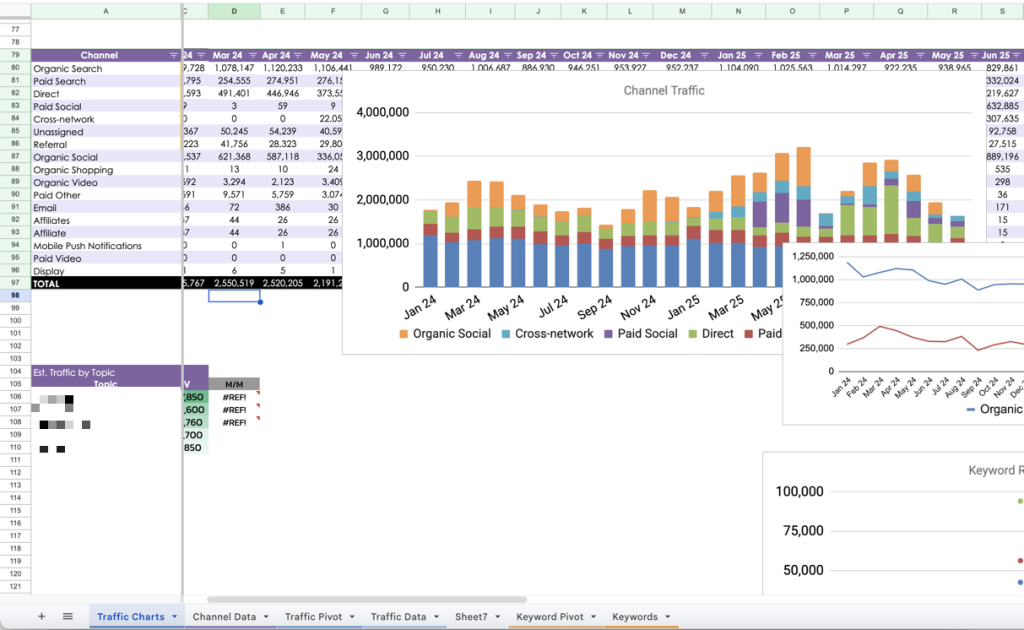
You do…
Source: Google Ads, January 2026, THIS IS WHAT I WANT YOU TO SEE tab.
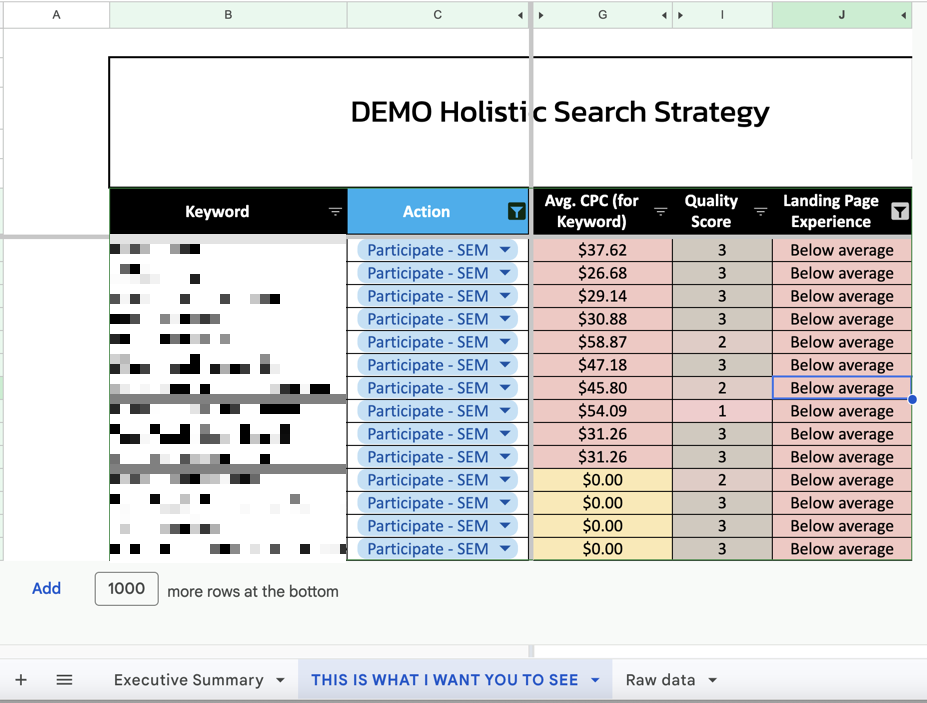
Less…

More…

Now, I know what you’re thinking, “Waitaminute, you’re telling me, I gotta create a deck AND polish my sheets?”
Yes.
Inviting a client or even an internal person (to QA) your work with your chicken scratch is effectively the equivalent of “Hey, play this game, it gets real good after 20 hours.”
Buddy…
I’m not going to invest 20 hours — let alone 3 honestly — in a video game if I’m not hooked right away, that’s literally why a VERTICAL SLICE exists; that’s why Samus starts fully powered before the game begins (by taking everything away).”
Polishing is part. of. the. JOB.
I’m an SEO, not a Designer
There’s an unhealthy amount of this in SEO (as an industry). At least 50% of people I’ve worked with believe that, the “I do SEO, not Design” and I’ve seen it at every level of pedigree.
And they’re wrong.
Henry Petroski goes over this in a bunch of books, in which he shows:
- A) everyone is inherently an engineer (see Humpty Dumpty) and
- B) AESTHETICS is a critical part of engineering.
He showcases this with the paperclip.
We’re all familiar with the “Gem” design. If you’re tasked to draw a paperclip, chances are you’re going to draw the “Gem” designed paperclip. And there have been improvements since the Gem design, cus the Gem design kinda blows. It’s remarkable weak, it’ll pinch the paper, and it’ll lose its form with more pages of paper. But the gem design is ubiquitous with paperclips — probably in no small part due to Clippy (brilliant IP move, but I digress). Aesthetics are part of what makes a product live or die. So make it look NICE or no one will BUY IT.
BUT — I hear the you rumbling — BUT if I polish the sheet to show only the PERTINENT information… isn’t that deceptive? Am I not hurting trust with the client? Am I no better than a liar?
No.
Look, I’m already on a tangent, so I’ll go there, but my favorite part about SEO is the fact that if you’re doing high caliber work, it’ll play out like Inception.
The SEO Heist & Inception’s Time Dialation
You drill down deep into the intended users’ labyrinthine subconsciousness to understand their search intent. The client in this case, is Cillian Murphy.

If you’ve done your job well, the client thinks what you’re doing is their idea. They look great to their bosses and you champion their growth from the sidelines (this is part of a fundamental improv rule: make each other look good.)
Meanwhile, each layer of dream is basically increasing tiers of internal hierarchy. Yusuf is your specialist, they’re there in tier one, mostly serving as your down in the weeds, unaware of lower levels, but CRITICAL to deadlines and taking care of the work.
Arthur’s your strategist, able to handle a bit more complexity and chaotic environments (how to kick without gravity), they’re in the dilated time.
Your boss is probably Tom Hardy, effortlessly jumping in on the lower levels, mastery of efficiency, and coming up with impromptu ideas on the fly.
And you’re Leonardo DiCaprio — going to the depths for years on end…
BUT you don’t turn that deep dive into a tourist attraction; YOU DO NOT bring your boss OR your client down to limbo. They do not need to see your demons. It’s your job to bubble insights back up to the top layer.
The deep dive is why you — or I — do SEO, not why someone pays you to do it. They pay you for the end result: the idea. Ergo, it’s not misleading or lying to curate your “work” into something presentable; taking them with you will do NOTHING for your relationship. Again, they don’t want the raw, unfiltered spreadsheet, they want the insight; the idea.
Nothing is more DANGEROUS than an idea.
Telling the Truth “Slant”
Put another way, let’s continue to diverge from math and into English with one of my favorite Emily Dickinson poems:
Tell all the truth but tell it slant–
Emily Dickinson, [Poem] 1263
Success in Circuit lies
Too bright for our infirm Delight
The Truth’s superb surprise
As Lightning to the Children eased
With explanation kind
The Truth must dazzle gradually
Or every man be blind–
Basically, she says, the truth is like the sun. If you tell someone the whole truth, they’ll go blind; it’s why you need to tell it slanted, dazzle gradually, polish your poultry.
A lot of these principles can be pulled from Making Numbers Count by Chip Heath and Karla Starr wherein they talk ad nauseum how the larger your numbers become, the less impactful they are:
- Is it meaningful to say X million of Americans suffer from [DISORDER]? or
- Is it more meaningful to say 1 in 10 Americans suffer from [DISORDER]?
Obviously, it’s the second one. 1 in 10 makes it personal; you know 1 in 10 people… you probably don’t know millions.
In action? There’s a pool-cover company (Loop-Loc) that doesn’t advertise the total weight its pool covers can support, it advertises Bubbles, the baby African elephant:

F***ing brilliant.
Tell me it can support X pounds or stones or kilograms — I’ll shrug. Tell me it can support Bubbles, and I GET IT.
Don’t Blind your Client with the Sun
If you give someone your raw audit and explain your XLOOKUPs and INDEX formulas, they’ll go blind from complexity. Turning your chicken scratch into polished poultry ain’t lying, it’s being a good gosh darn host.
To a stakeholder, two months of keyword research — even with inception tiers of audience deep dives — still sounds like a waste of time. This is also why keyword rankings get so many SEOs into trouble (i.e. I searched [that keyword you said I ranked for] and I didn’t see us populate at all [it’s also why I believe any good SEO package is deeply entrenched in content production and/or strategy, but that’s a blog for another time]).
The point is, if you want the CMO to buy the work, you have to give them the vertical slice, and let your insights dazzle gradually.
